Gravity-Based Representative Sampling for Frugal Graph Learning on Metal-Organic Framework Networks
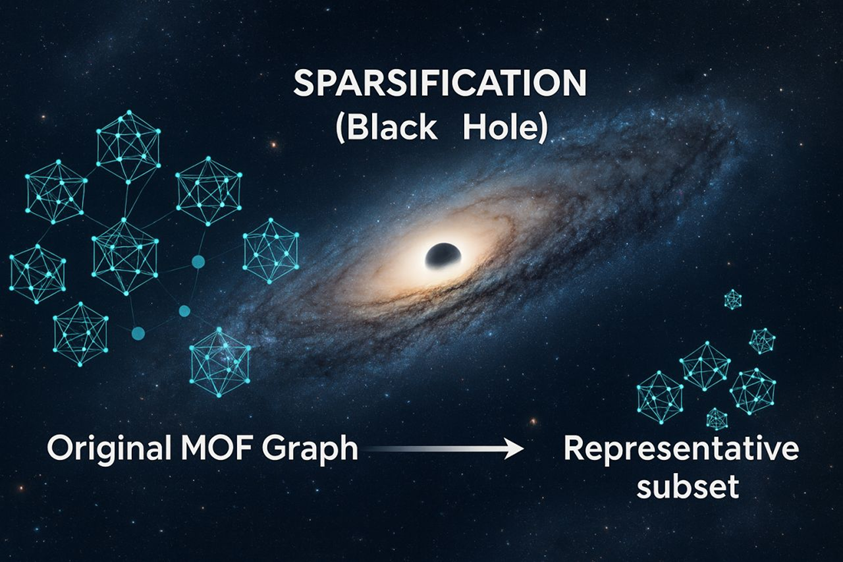
The Black Hole Strategy is a structure-aware sampling project for large MOF similarity networks. It ranks nodes with a gravity score built from degree centrality, betweenness, and neighborhood influence, then keeps compact and representative subsets. In the paper, GNN models trained on Black Hole-sparsified graphs retain strong predictive performance with lower memory and training cost.
Why Black Hole?
- Removes redundancy and low-information nodes while preserving representative structure-property coverage.
- Uses a gravity score built from degree, betweenness, and neighborhood influence.
- Keeps modularity, diversity, and connectivity across multiple sparsification levels.
- Published in the Journal of Chemical Information and Modeling as a frugal graph learning strategy for MOFs.
Where can it be used?
- MOF screening, property prediction, and structure-property mapping.
- Efficient GNN training on large similarity graphs with reduced memory cost.
- FAIR-oriented data curation and scalable discovery workflows.
- Extensions to active learning, GraphRAG, and knowledge-driven scientific AI.
Research context at SRH
This project highlights SRH University Heidelberg’s role in AI-enabled materials discovery and frugal graph learning. The paper includes SRH University of Applied Sciences Heidelberg among the author affiliations and presents a scalable, interpretable, FAIR-oriented approach for materials informatics.